


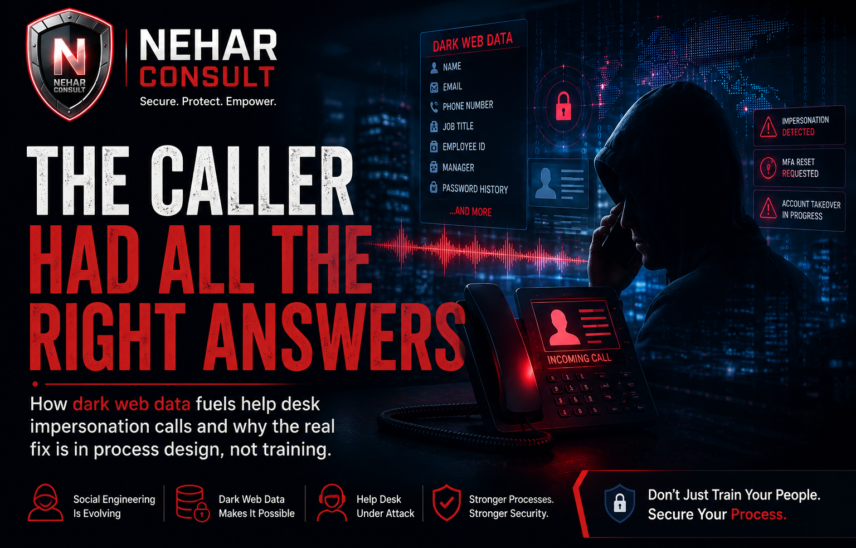
Help desk social engineering has emerged as one of the most effective initial access techniques in modern cyberattacks. Unlike traditional phishing campaigns that depend on malicious links or infected attachments, these attacks exploit something far more difficult to secure—human trust embedded in organizational support processes.
Today, cybercriminals do not always need advanced malware or technical exploits to breach an organization. In many cases, they simply pick up the phone.
Armed with stolen credentials, personal data, and publicly available corporate information, attackers can convincingly impersonate legitimate users. By doing so, they manipulate IT support teams into resetting passwords, bypassing multi-factor authentication (MFA), enrolling unauthorized devices, or granting direct account access.
The most concerning reality is this: attackers often already know the answers to verification questions before the conversation even begins.
In recent years, ransomware groups, credential theft operations, and access brokers have increasingly turned to help desk social engineering as a primary attack vector. The reasons are clear—it is low-cost, scalable, difficult to detect, and highly effective.
Rather than targeting software vulnerabilities, these attackers exploit weaknesses in identity verification and operational procedures.
Threat actors commonly impersonate:
Their goal is straightforward: convince support personnel of their legitimacy long enough to gain access.
Many organizations still rely on outdated, knowledge-based authentication methods, such as:
Unfortunately, much of this information is no longer private. It is widely accessible through:
As a result, attackers often enter interactions fully prepared—with accurate, verifiable information that matches internal records. To a help desk agent, everything appears legitimate.
Modern cybercriminal ecosystems operate with increasing sophistication. Underground marketplaces and access brokers now sell comprehensive identity packages that enable highly targeted impersonation.
These packages can include:
A single compromised profile may contain extensive data, including contact details, password history, device information, and reporting structures.
When combined with AI-driven voice cloning and scripted social engineering techniques, attackers can create highly convincing interactions that bypass traditional verification controls.
Organizations often respond to social engineering threats by investing in employee awareness training. While this remains an important layer of defense, it does not address the root of the problem.
Help desk personnel are typically evaluated based on:
At the same time, they are expected to detect increasingly sophisticated deception attempts in real time.
This creates a fundamental conflict:
Deliver fast, seamless support while simultaneously identifying highly convincing fraud attempts.
Without stronger technical controls and identity assurance mechanisms, even experienced staff can be manipulated.
Multi-factor authentication is widely viewed as a critical security control, but it is not immune to social engineering.
Attackers increasingly target MFA enrollment processes by attempting to:
Once successful, they gain legitimate, authenticated access without needing to crack passwords or deploy malware.
Several high-profile incidents in recent years have demonstrated that help desk-assisted MFA compromise can serve as a direct path to full account takeover.
The core issue is not simply user awareness—it is process design.
When attackers already possess accurate personal information, identity verification based on static knowledge becomes ineffective. Organizations must move toward more resilient and adaptive authentication models.
Key improvements include:
Support teams should never rely solely on easily obtainable personal data for identity validation.
To mitigate the risk of help desk social engineering, organizations should implement several critical controls:
Information such as employee IDs or birth dates should no longer be treated as secure authentication factors.
Require additional approvals or secondary validation for:
Security teams should watch for:
Regular red team exercises and simulated social engineering scenarios can help identify weaknesses in help desk processes before attackers do.
Help desk social engineering represents a fundamental shift in cyber threats—from exploiting systems to exploiting trust.
Attackers understand that the easiest way into an organization is often through processes designed for speed and convenience. When they already possess the “right answers,” traditional identity verification methods quickly break down.
The future of defense will depend not just on employee vigilance, but on building systems and processes that remain secure even when attackers appear completely legitimate.
At Nehar Consult, we empower your employees with hands‑on, real‑world security awareness training that significantly reduces the risk and impact of identity theft. As a result, your workforce becomes a resilient, frontline human firewall—all while staying fully engaged in their day‑to‑day responsibilities. Beyond training, we work closely with your organization to navigate and complete the required cybersecurity frameworks, ensuring full CSAT fulfillment with clarity, confidence, and regulatory readiness.
Security Awareness Training Assessment Tool :
Schedule your next appointment here:
Check how strong your password is with Free Nehar Password Check:
Check what PCI DSS SAQ form is appropriate for your organization with our Free Calculator:
@NITDANigeria @ndpcngr @FMCIDENigeria @fccnigeria @CBNNIGERIAORG @FINTECHCircle @nnpclimited @Nairametrics