


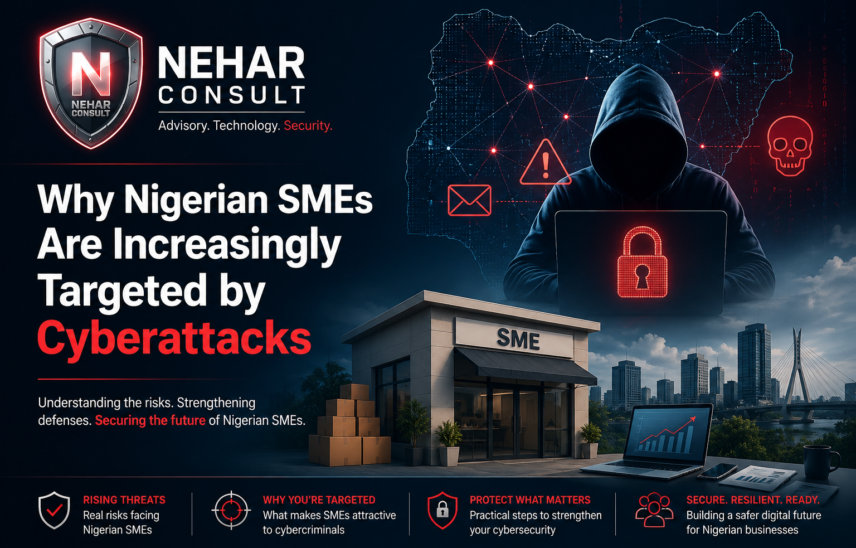
Nigerian small and medium enterprises (SMEs) are facing a rising wave of cyberattacks, driven by a hard truth: most hackers are not targeting them individually. Instead, cybercriminals deploy automated tools that scan the internet for weaknesses—essentially looking for any “unlocked digital doors.” Businesses that assume they are too small to attract attention often leave those doors open, making themselves easy targets.
One of the biggest misconceptions among SME owners is the belief that cybercriminals only go after large corporations, banks, or global enterprises. In reality, modern attacks are largely automated. Hackers use scanning tools to probe thousands of websites, servers, and networks simultaneously, searching for known vulnerabilities, weak passwords, or outdated software.
If a business has an online presence, handles financial transactions, or stores customer data, it is already within scope. Size does not determine risk—exposure and vulnerability do.
Cyber threats have evolved beyond technical exploits. Today, attackers increasingly target people rather than systems, exploiting what is often called “the human layer.” In Nigeria, this has led to a surge in social engineering tactics such as phishing and Business Email Compromise (BEC).
These attacks are becoming more sophisticated and localized. With the help of AI tools, cybercriminals craft convincing emails with perfect grammar, urgent messaging, and realistic contexts tailored to Nigerian businesses. Once an employee falls victim and shares login credentials, attackers can infiltrate the organization quietly.
From there, they may intercept invoices, alter banking details, or deploy ransomware—all without immediately raising alarms.
Nigeria’s challenging economic environment has also contributed to the problem. With inflation, currency fluctuations, and tight operating margins, many SME owners are forced to prioritize spending carefully.
Unfortunately, cybersecurity is often perceived as an optional expense rather than a fundamental business requirement. As a result, businesses may:
These cost-cutting decisions create vulnerabilities that attackers are quick to exploit.
Another major issue is the gap between general IT support and proactive cybersecurity. Many SMEs believe they are protected simply because they have someone managing their computers or a basic firewall in place.
However, cybersecurity requires more than maintenance—it demands strategy. Most SMEs lack advanced safeguards such as a Zero Trust framework, where no user or device is automatically trusted. Without such controls, a single compromised account can grant attackers unrestricted access to the entire system.
This over-reliance on minimal protections leaves businesses exposed to modern, sophisticated threats.
Even when SME owners are willing to improve security, they often face a lack of clear, practical guidance. Cybersecurity is frequently explained in complex technical terms that do not resonate with busy entrepreneurs.
What many business owners need is straightforward, actionable advice—steps they can realistically implement without requiring a full-scale IT department. The absence of accessible education creates a barrier that keeps SMEs from taking effective protective measures. At Nehar Consult, we improve Security Culture of your organization by making security every employees duty.
The impact of a cyberattack extends far beyond immediate financial loss. While theft is a major concern, the operational disruption can be even more damaging.
Ransomware or BEC attacks can bring business operations to a complete halt:
For many SMEs, this disruption proves fatal. Without adequate preparation and recovery plans, a major breach can force a business to shut down within months.
The growing vulnerability of Nigerian SMEs to cyberattacks is not due to their size, but rather a combination of misconceptions, economic pressures, limited security practices, and lack of accessible guidance. As cyber threats become increasingly automated and human-focused, ignoring cybersecurity is no longer an option.
Protecting a business today means recognizing that every organization—no matter how small—is a potential target, and taking proactive steps to secure both systems and people before attackers find the opportunity.
At Nehar Consult, we empower your employees with hands‑on, real‑world security awareness training that significantly reduces the risk and impact of identity theft. As a result, your workforce becomes a resilient, frontline human firewall—all while staying fully engaged in their day‑to‑day responsibilities. Beyond training, we work closely with your organization to navigate and complete the required cybersecurity frameworks, ensuring full CSAT fulfillment with clarity, confidence, and regulatory readiness.
Security Awareness Training Assessment Tool : Check your eligibility here
Schedule your next appointment here: Book your Appointment
Check how strong your password is with Free Nehar Password Check: Click here
Check what PCI DSS SAQ form is appropriate for your organization with our Free Calculator: Check here