


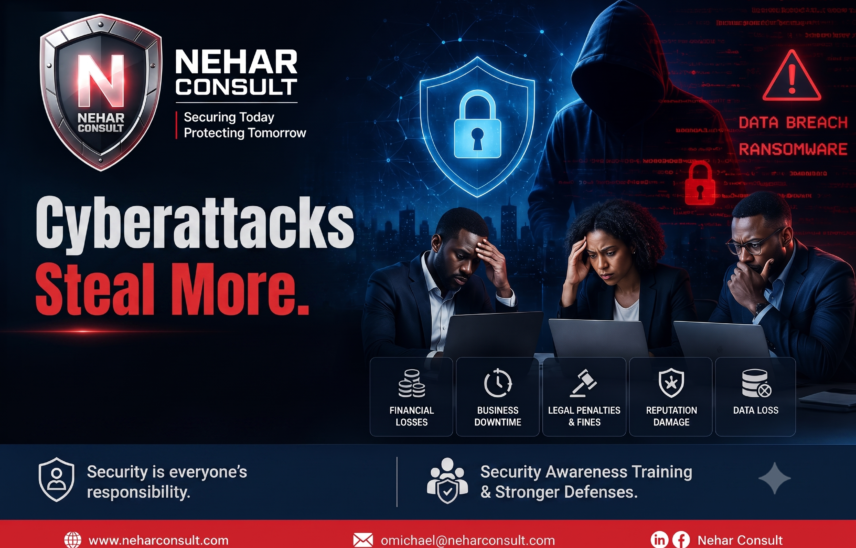
Organizations can significantly reduce the risk and impact of cyberattacks, including data breaches and ransomware incidents, by implementing a combination of technical safeguards, administrative controls, and employee-focused security measures.
One of the most effective cybersecurity investments is ongoing security awareness training. Employees should be regularly educated on how to recognize phishing emails, social engineering tactics, malicious attachments, suspicious links, and other common cyber threats. A well-informed workforce serves as the organization’s first line of defense—the human firewall. By equipping employees with the knowledge to identify and report suspicious activity, organizations can significantly reduce the likelihood of successful cyberattacks and unauthorized access.
Regular phishing simulation exercises help organizations assess employee awareness, reinforce secure behaviors, and identify areas where additional training may be needed. These simulations provide valuable insights into organizational vulnerabilities and strengthen employees’ ability to recognize real-world phishing attempts.
Implementing Multi-Factor Authentication (MFA) for critical systems, applications, and remote access significantly enhances account security. Even if an attacker obtains a user’s password, MFA adds an additional layer of verification that helps prevent unauthorized access.
Keeping operating systems, applications, and network devices up to date is essential. Timely application of security patches helps eliminate known vulnerabilities before attackers can exploit them. A robust patch management program reduces the organization’s exposure to emerging threats.
Organizations should maintain regular, encrypted, and offline backups of critical data. Backup systems should be tested periodically to ensure they can be restored quickly during an incident. Effective backup and recovery capabilities help maintain business continuity and reduce reliance on attackers during ransomware events.
Advanced Endpoint Detection and Response (EDR) solutions provide real-time monitoring, threat detection, and automated response capabilities. These tools can identify malicious activity early, isolate affected devices, and limit the spread of attacks across the organization.
Because email remains one of the primary attack vectors, organizations should implement comprehensive email security measures, including anti-phishing protection, spam filtering, anti-malware solutions, and email authentication protocols such as SPF, DKIM, and DMARC. These controls help reduce the risk of email-based attacks and spoofing attempts.
Applying the principle of least privilege ensures that employees have access only to the data and systems necessary to perform their job responsibilities. Restricting access minimizes potential damage if an account is compromised and reduces the attack surface available to threat actors.
A documented and regularly tested incident response plan enables organizations to respond quickly and effectively during a cyber incident. Clear procedures, defined roles, and periodic exercises help reduce confusion, limit damage, and accelerate recovery efforts.
Cyber insurance can provide financial protection by helping cover costs associated with incident response, legal expenses, regulatory fines, business interruption, forensic investigations, and recovery efforts. While not a substitute for strong security controls, it can be an important component of a comprehensive risk management strategy.
Routine vulnerability assessments, penetration tests, and security audits help identify weaknesses before attackers can exploit them. Regular assessments allow organizations to proactively strengthen their security posture and address emerging risks.
Technology alone cannot prevent every cyberattack. Human error continues to be one of the leading contributors to data breaches, whether through phishing, weak passwords, accidental data exposure, or social engineering. As a result, security awareness training remains a critical component of any cybersecurity strategy.
A well-trained workforce can:
Effective cybersecurity requires a layered defense strategy that combines people, processes, and technology. By investing in ongoing security awareness training and implementing strong technical controls such as MFA, EDR, email security, access management, and regular security assessments, organizations can substantially reduce both the likelihood and impact of cyberattacks. Continuous education transforms employees from a potential security weakness into one of the organization’s most valuable cybersecurity assets.
At Nehar Consult, we empower your employees with hands‑on, real‑world security awareness training that significantly reduces the risk and impact of identity theft. As a result, your workforce becomes a resilient, frontline human firewall—all while staying fully engaged in their day‑to‑day responsibilities. Beyond training, we work closely with your organization to navigate and complete the required cybersecurity frameworks, ensuring full CSAT fulfillment with clarity, confidence, and regulatory readiness.
Security Awareness Training Assessment Tool : Check your eligibility here
Schedule your next appointment here: Book your Appointment
Check how strong your password is with Free Nehar Password Check: Click here
Check what PCI DSS SAQ form is appropriate for your organization with our Free Calculator: Check here