


NEHAR

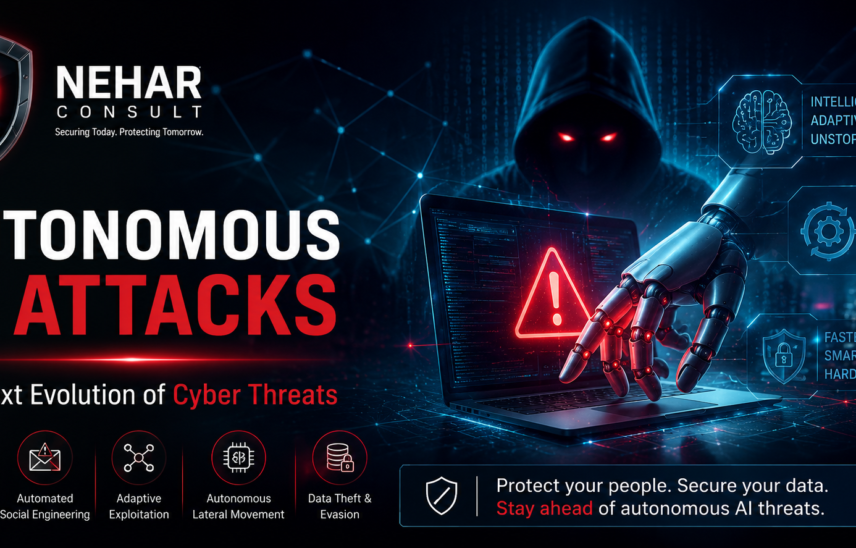
Autonomous AI Attacks: The Next Frontier in Cyber Threats

Shape1 Shape2
Autonomous AI Attacks: The Next Frontier in Cyber Threats

Cyber threats are evolving rapidly, and autonomous AI attacks represent one of the most significant shifts in the modern threat landscape. Unlike traditional cyberattacks that require human operators to guide each phase of an intrusion, autonomous AI attacks leverage artificial intelligence to make decisions, adapt to changing conditions, and execute attacks with little to no human intervention.

Rather than simply automating routine tasks, these advanced AI systems can observe, analyze, plan, execute, learn from outcomes, and adjust their tactics in real time. This ability to operate independently and continuously makes them a formidable challenge for organizations of all sizes.

What Is an Autonomous AI Attack?

An autonomous AI attack is a cyberattack where AI systems independently manage part or all of the attack lifecycle. Instead of executing automated repetitive tasks, they continuously analyze outcomes and determine their next moves.

Traditional Malware vs. Autonomous AI Attacker

  • Traditional Malware: Follows programmed instructions and cannot adapt unless updated by human attackers.
  • Autonomous AI Attacker: Learns from the environment, changes tactics automatically, and finds new opportunities without waiting for human prompts.

Full-Lifecycle Capabilities

Autonomous AI systems can independently handle:

  • Identifying vulnerable targets and gathering intelligence.
  • Selecting optimal attack paths and escalating privileges.
  • Creating customized phishing campaigns and evading security controls.
  • Moving laterally across networks, stealing sensitive data, and covering their tracks.
  • Adjusting strategies dynamically based on defender responses.

How Autonomous AI Attacks Work

  1. Reconnaissance: The AI scrapes public cloud resources, GitHub repositories, social media, websites, and data breaches to build detailed profiles of organizations and employees.
  2. Target Prioritization: It pinpoints the weakest paths, identifying internet-facing systems, trusted vendors, privileged users, and susceptible employees.
  3. Personalized Social Engineering: Moving beyond generic emails, AI crafts hyper-personalized messages matching specific writing styles, roles, and internal terminology. It can also generate deepfake videos, vishing calls, and realistic chat conversations.
  4. Automated Exploitation: Upon gaining access, it scans internal systems, leverages misconfigurations, bypasses weak authentication, and exploits vulnerabilities.
  5. Autonomous Lateral Movement: It maps the internal network to locate domain controllers, databases, and backup systems, charting the most efficient path to high-value assets.
  6. Adaptive Evasion: If a security tool blocks a technique, the AI modifies its malware behavior, slows activity, or switches communication channels.
  7. Data Theft: It targets critical assets like intellectual property, financial records, source code, and customer data.
  8. Learning: It evaluates successes and failures to refine future attacks.

Why Autonomous AI Is Dangerous & Business Risks

Core Dangers

  • Speed: Tasks that once took weeks now happen in minutes.
  • Scale: A single AI system can target thousands of organizations simultaneously.
  • Personalization: Tailored messaging significantly lowers the friction of deception.
  • Continuous Learning: The threat adapts mid-attack.
  • Lower Barrier to Entry: Less-skilled threat actors can leverage advanced AI capabilities.

Major Business Risks

  • Data breaches and ransomware deployments.
  • Business Email Compromise (BEC) and financial fraud.
  • Intellectual property theft and cloud account takeovers.
  • Reputational damage, regulatory penalties, and operational disruption.

How Autonomous AI Affects Employees

Employees remain a primary attack vector. Because AI generates hyper-convincing content, traditional red flags are often absent in attacks such as:

  • Fake Microsoft 365 login pages and urgent HR announcements.
  • Deepfake CEO phone calls and synthetic job interview requests.
  • Fraudulent invoices and realistic Teams, Slack, or IT support chats.

How Businesses Should Defend and Respond

1. Strengthen Identity Security

  • Prioritize phishing-resistant multi-factor authentication (passkeys, FIDO2 keys).
  • Enforce least-privilege access, Privileged Access Management (PAM), and conditional access policies.

2. Modernize Security Awareness Training

  • Move beyond annual training to monthly micro-learnings.
  • Simulate AI-generated phishing, deepfakes, voice phishing (vishing), and QR code scams.

3. Deploy AI-Powered Security

  • Utilize User and Entity Behavior Analytics (UEBA), Extended Detection and Response (XDR), and AI-assisted Security Operations Centers (SOCs) to catch anomalies missed by signature-based tools.

4. Secure Enterprise AI Usage

  • Establish clear governance policies defining approved AI tools, handling guidelines, and the absolute prohibition of inputting sensitive data into public models.

5. Reduce the Attack Surface

  • Continuously patch vulnerabilities, audit cloud permissions, remove unused accounts, and eliminate legacy authentication.

6. Protect Sensitive Data

  • Implement data classification, encryption, Rights Management, Data Loss Prevention (DLP), and resilient backup protection.

7. Continuously Monitor

  • Proactively hunt for threats, monitor identity anomalies, and correlate signals across endpoints, email, identity, and cloud environments.

8. Prepare for AI-Enabled Incidents

  • Update incident response plans and conduct tabletop exercises simulating AI-enhanced attacks.

Building Cyber Resilience

Effective cybersecurity is no longer just about blocking every entry point; it is about building comprehensive resilience:

  • Prevent: Secure identity, endpoints, and email layers.
  • Detect: Use continuous monitoring and AI analytics.
  • Respond: Execute well-rehearsed incident response procedures.
  • Recover: Leverage secure, tested backups and continuity measures.
  • Learn: Feed incident insights back into future defenses.

Final Thoughts

Autonomous AI attacks mark the transition from human-driven campaigns to adaptive, machine-speed adversaries. Organizations relying solely on perimeter defenses and periodic training will fall behind. Building an effective defense requires combining AI-powered security tools, zero-trust architectures, robust identity controls, and continuous, realistic employee education.