


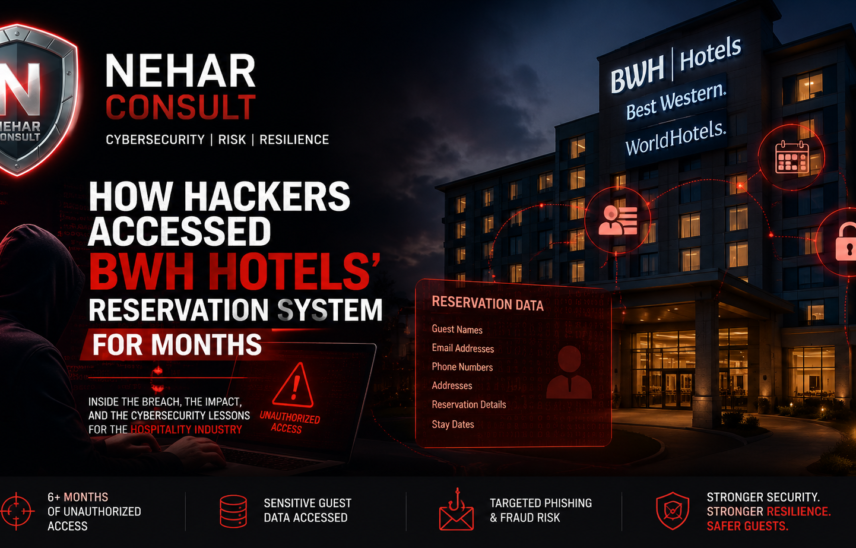
The hospitality industry has become an increasingly attractive target for cybercriminals, and the recent breach involving BWH Hotels clearly demonstrates why. In this case, attackers maintained unauthorized access to the company’s reservation environment for more than six months before anyone detected the intrusion. As a result, they exposed sensitive guest reservation data and underscored ongoing weaknesses in hotel cybersecurity infrastructure.
According to public reports, the compromise began around October 2025 and continued undetected until April 2026. During this period, attackers actively accessed a web application connected to hotel reservation operations.
Although BWH Hotels has not disclosed the exact attack method, evidence suggests that the attackers targeted an internet-facing reservation platform containing customer booking information. More specifically, cybersecurity analysts suspect that the attackers exploited common weaknesses in hospitality environments. These likely included outdated web applications, weak authentication controls, compromised administrator credentials, or inadequate monitoring systems.
Importantly, the attackers focused on systems supporting guest reservations rather than payment processing infrastructure. BWH Hotels confirmed that the compromised application did not store payment card data.
As the intrusion progressed, attackers accessed several types of reservation-related data, including:
Even though financial information may not have been involved, this type of data still holds significant value for cybercriminals.
Reservation data enables highly targeted phishing and social engineering attacks. Unlike generic spam campaigns, these attacks use real booking details to appear credible and convincing.
For instance, victims might receive:
Because these messages include legitimate travel dates, hotel names, and reservation details, recipients are far more likely to trust them. Consequently, this type of targeted fraud has become increasingly common across the travel and hospitality sector.
Perhaps most concerning, the attackers maintained access for over six months. Such an extended dwell time typically indicates systemic security gaps.
Specifically, this duration suggests weaknesses in:
At the same time, many hospitality organizations rely on interconnected legacy systems, third-party booking integrations, and franchise-based infrastructures. These complexities often make centralized security oversight more difficult. As a result, attackers can establish persistence and operate undetected for extended periods.
Hotels and travel platforms remain prime targets because they store large volumes of personal data while maintaining highly accessible, customer-facing systems. In particular, reservation platforms present an appealing attack surface because they combine:
Together, these elements create opportunities not only for data theft but also for fraud, espionage, and follow-on attacks.
After discovering the breach, BWH Hotels took several immediate actions. The company:
In addition, the organization has started implementing stronger security measures to improve monitoring and protect reservation systems moving forward.
Ultimately, the BWH Hotels breach highlights several key cybersecurity lessons for the hospitality industry:
For travelers, the incident serves as an important reminder. Always approach unexpected emails or messages about hotel reservations with caution—even when the details appear accurate and legitimate.
At Nehar Consult, we empower your employees with hands‑on, real‑world security awareness training that significantly reduces the risk and impact of identity theft. As a result, your workforce becomes a resilient, frontline human firewall—all while staying fully engaged in their day‑to‑day responsibilities. Beyond training, we work closely with your organization to navigate and complete the required cybersecurity frameworks, ensuring full CSAT fulfillment with clarity, confidence, and regulatory readiness.
Security Awareness Training Assessment Tool :
Schedule your next appointment here:
Check how strong your password is with Free Nehar Password Check:
Check what PCI DSS SAQ form is appropriate for your organization with our Free Calculator:
@NITDANigeria @ndpcngr @FMCIDENigeria @fccnigeria @CBNNIGERIAORG @FINTECHCircle @nnpclimited @Nairametrics