


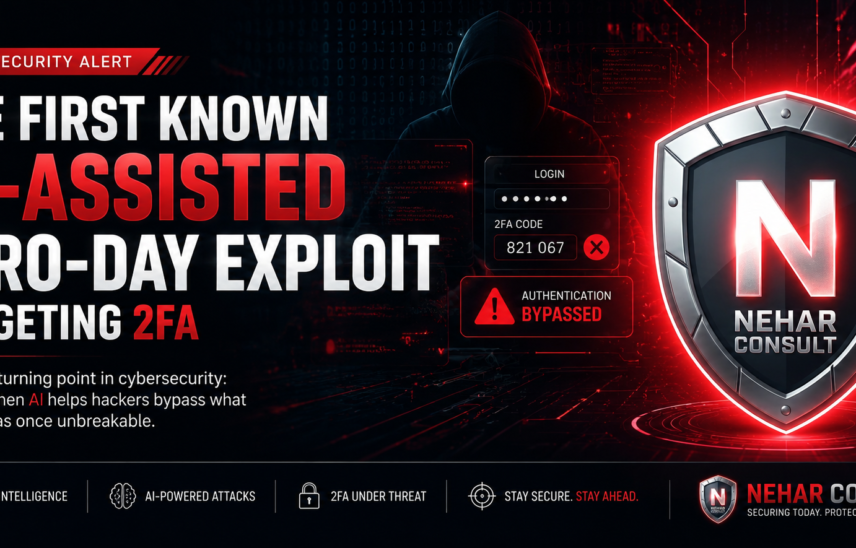
The cybersecurity landscape may be entering a new era—and recent findings suggest that shift is already underway.
In May 2026, Google researchers reportedly identified what could be the first documented case of attackers using artificial intelligence to help develop a zero‑day exploit capable of bypassing two‑factor authentication (2FA). Google’s Threat Intelligence Group (GTIG) attributed the discovery and, in doing so, sparked widespread concern about AI’s growing role in offensive cyber operations.
According to multiple cybersecurity reports, attackers used AI tools to uncover and exploit a previously unknown vulnerability in an open‑source web administration platform. Specifically, the exploit enabled them to bypass 2FA by taking advantage of flaws in the application’s authentication logic.
Although cybercriminals have already used AI for phishing, malware obfuscation, and social engineering, this case marks a significant escalation. In this instance, the AI system actively contributed to:
Importantly, researchers identified the exploit before attackers could deploy it widely, thereby preventing a large‑scale campaign.
This development signals a major shift in cybersecurity. More importantly, it demonstrates that AI can now assist in complex vulnerability discovery and exploit development—tasks that traditionally required deep human expertise.
In the past, security researchers needed extensive manual testing, specialized knowledge, and a strong understanding of software internals to uncover zero‑day vulnerabilities. Now, however, AI-assisted tools may dramatically accelerate that process.
Furthermore, researchers emphasized that this vulnerability did not stem from a simple coding mistake. Instead, it arose from a faulty trust assumption within the authentication workflow. Because identifying such issues requires reasoning about application logic and user interactions, the incident highlights a new level of AI capability.
To understand the significance, it’s important to define the term. A zero‑day exploit targets a vulnerability that vendors have not yet discovered or patched. As a result, defenders have “zero days” to prepare, making these attacks especially dangerous.
Typically, zero‑day exploits are associated with:
Now, with AI accelerating the discovery process, the barrier to developing such exploits could decrease.
Despite the headlines, the AI did not operate independently.
Instead, human operators guided the process at every stage. They directed prompts, refined outputs, validated exploit chains, and manually tested attack methods. In other words, the AI acted as an advanced research assistant rather than an autonomous attacker.
For years, cybersecurity experts have warned that AI would eventually become embedded in offensive operations. Now, this case provides concrete evidence that those predictions are materializing.
As a result, several risks are becoming more apparent:
Moreover, as AI capabilities continue to evolve, attackers may gain the ability to iterate rapidly and adapt in near real time—further challenging defenders.
Given these developments, organizations cannot rely solely on traditional defenses. Instead, they should adopt a layered and adaptive security approach.
Security professionals recommend:
Additionally, organizations should carefully review authentication workflows. Increasingly, attackers exploit logic flaws—not just technical bugs—making these reviews critical.
Ultimately, the rise of AI-assisted zero‑day development marks a pivotal moment. While human expertise still plays a central role, AI is reshaping how vulnerabilities are discovered and exploited.
At the same time, this technology presents a dual‑use challenge. While defenders can leverage AI to improve detection and automate responses, attackers can also use it to operate faster and more effectively.
Consequently, the cybersecurity arms race is evolving. It is no longer just human versus human.
Increasingly, it is becoming AI versus AI.
At Nehar Consult, we empower your employees with hands‑on, real‑world security awareness training that significantly reduces the risk and impact of identity theft. As a result, your workforce becomes a resilient, frontline human firewall—all while staying fully engaged in their day‑to‑day responsibilities. Beyond training, we work closely with your organization to navigate and complete the required cybersecurity frameworks, ensuring full CSAT fulfillment with clarity, confidence, and regulatory readiness.
Security Awareness Training Assessment Tool : Check your eligibility here
Schedule your next appointment here: Book your Appointment
Check how strong your password is with Free Nehar Password Check: Click here
Check what PCI DSS SAQ form is appropriate for your organization with our Free Calculator: Check here