


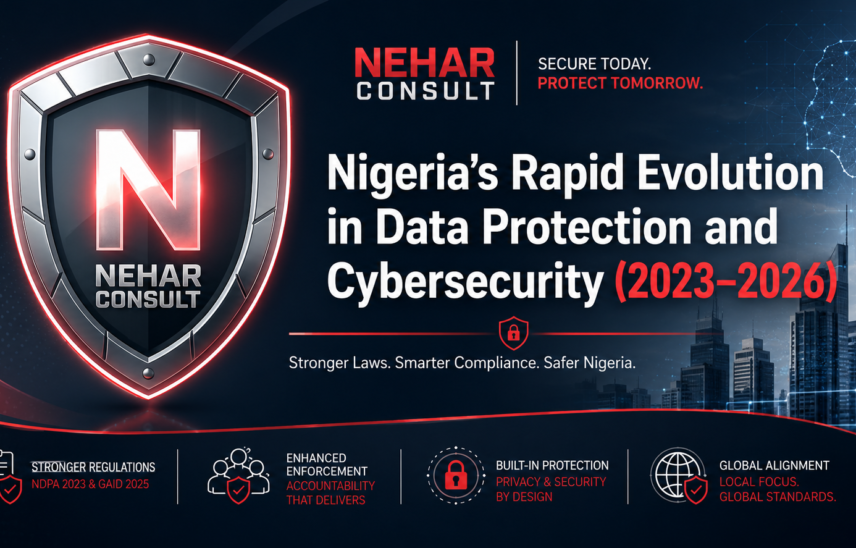
Nigeria has undergone a significant transformation in its data protection and cybersecurity landscape between 2023 and 2026. What was once a basic privacy framework has evolved into a more structured, enforcement-driven regime led by the Nigeria Data Protection Commission (NDPC).
At the center of this shift is a clear priority: strengthening digital trust, protecting citizens’ data, and aligning with global standards.
The Nigeria Data Protection Act (NDPA) 2023 marked a turning point. It established a modern legal framework for data privacy while formally empowering the NDPC as an independent regulator.
The Act goes beyond high-level principles by introducing enforceable obligations around lawful data processing, consent, security safeguards, breach notification, and cross-border data transfers. It also strengthens individual rights—giving Nigerians more control over their personal data, including access, correction, deletion, and objection to processing.
The General Application and Implementation Directive (GAID) 2025 represents the operational backbone of the NDPA. It replaces the earlier NDPR 2019 and shifts the focus from guidance to execution.
GAID introduces stricter compliance requirements, including:
This framework signals a move toward active enforcement and measurable compliance.
Nigeria now requires organizations handling significant personal data volumes to register with the NDPC. This applies across sectors such as fintech, telecoms, healthcare, e-commerce, SaaS, education, and government.
With thresholds as low as 200 data subjects within six months, the scope is intentionally broad—designed to increase visibility, accountability, and regulatory oversight.
A notable shift in Nigeria’s approach is the emphasis on proactive governance through:
Organizations are expected to integrate data protection into system architecture from the outset—minimizing data collection, implementing encryption, enforcing access controls, and embedding security into development lifecycles.
Regulators are now more assertive in enforcing breach reporting and incident response obligations. Organizations must:
This marks a transition toward continuous compliance monitoring and stricter enforcement actions, particularly in high-risk sectors.
Under the NDPA, Nigerian citizens now benefit from a more robust rights framework. Individuals can:
This alignment with global standards such as GDPR strengthens user trust and accountability.
As data flows become increasingly global, Nigeria has introduced stricter rules governing international transfers. Organizations must demonstrate:
This is particularly relevant for cloud providers, multinational firms, and SaaS platforms managing Nigerian data.
Nigeria’s evolving framework increasingly integrates data protection with cybersecurity and emerging technologies. Organizations are encouraged to adopt controls such as:
This reflects growing threats, including ransomware, phishing, deepfake fraud, and cloud-based vulnerabilities.
Nigeria is moving beyond basic compliance toward a model built on:
The direction is clear: a more mature, globally aligned ecosystem where data protection is not just a legal requirement—but a core component of organizational governance.
At Nehar Consult, we empower your employees with hands‑on, real‑world security awareness training that significantly reduces the risk and impact of identity theft. As a result, your workforce becomes a resilient, frontline human firewall—all while staying fully engaged in their day‑to‑day responsibilities. Beyond training, we work closely with your organization to navigate and complete the required cybersecurity frameworks, ensuring full CSAT fulfillment with clarity, confidence, and regulatory readiness.
Security Awareness Training Assessment Tool : Check your eligibility here
Schedule your next appointment here: Book your Appointment
Check how strong your password is with Free Nehar Password Check: Click here
Check what PCI DSS SAQ form is appropriate for your organization with our Free Calculator: Check here