


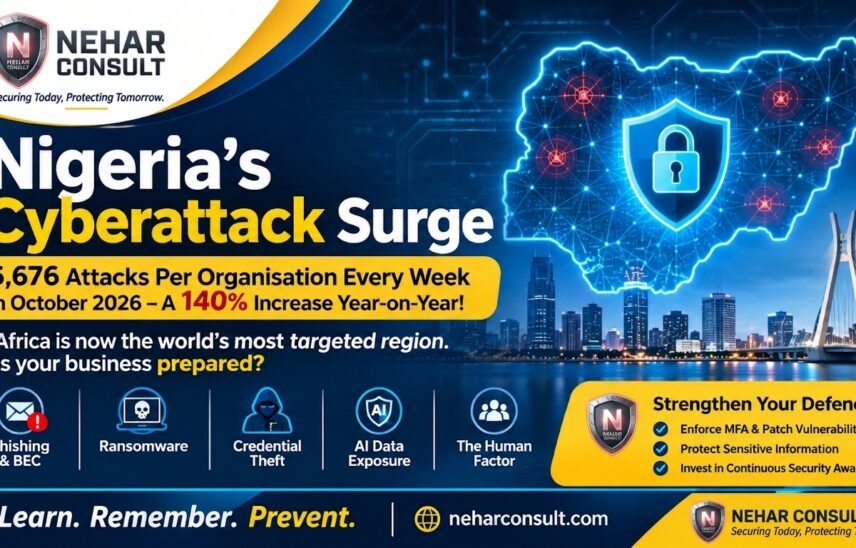
A 140% year-on-year increase should be a wake-up call for every Nigerian business.
Nigeria’s cybersecurity landscape is becoming increasingly challenging.
According to Check Point Research’s October 2026 Cyber Threat Landscape findings, Nigerian organizations experienced an average of 6,676 cyberattack events per organization per week, representing a 140% increase compared with October 2025.
This was reportedly the sharpest year-on-year increase among the countries covered in the research.
Even more concerning, Africa emerged as the world’s most targeted region, recording an average of 3,834 attacks per organization per week.
But what does this mean for Nigerian businesses?
It means the digital infrastructure supporting our financial services, healthcare institutions, government operations, telecommunications, and SMEs is operating in an increasingly hostile environment.
Cyberattacks are no longer limited to large corporations.
Small businesses, fintech companies, healthcare providers, professional service firms, and government contractors can all become targets.
Some of the major threats organizations should be preparing for include:
1. Identity and credential theft
Attackers increasingly exploit compromised passwords, phishing, password spraying, and stolen authentication tokens to gain access to organizational systems.
2. Ransomware and data extortion
Modern ransomware attacks can involve data theft, lateral movement, privilege escalation, and operational disruption before attackers demand payment.
3. Business Email Compromise (BEC)
Fraudulent emails and executive impersonation can lead to unauthorized financial transactions, supplier payment diversion, and confidential information disclosure.
4. Vulnerable infrastructure
Unpatched servers, exposed VPNs, unsecured remote access services, and misconfigured cloud environments can provide attackers with opportunities to enter business networks.
5. AI-related data exposure
Employees using unauthorized AI tools may inadvertently expose customer information, internal documents, technical configurations, and other sensitive business information.
Organizations may invest heavily in firewalls, endpoint protection, email security, and monitoring technologies.
However, technology alone cannot eliminate cybersecurity risks.
An employee who unknowingly opens a malicious attachment, shares credentials, approves a fraudulent MFA request, or discloses confidential information can create an opportunity for a serious security incident.
This is why cybersecurity awareness must become a continuous organizational activity.
Employees need practical training that helps them recognize threats, understand their responsibilities, and respond appropriately.
Annual presentations and occasional security reminders are not enough.
Organizations should implement continuous security awareness training, phishing simulations, secure authentication practices, and clear incident-reporting procedures.
The Nigeria Data Protection Act 2023, applicable CBN requirements, ISO/IEC 27001, and the NIST Cybersecurity Framework provide important foundations for managing information security risks.
However, compliance documentation alone does not protect an organization.
Security controls must be implemented, monitored, tested, and continuously improved.
Business leaders must recognize that cybersecurity is not simply an IT expense. It is an investment in business continuity, customer confidence, operational resilience, and organizational reputation.
If your organization experienced a successful phishing attack, ransomware incident, or compromised employee account today:
Would your employees recognize the warning signs?
Would your security team detect the activity?
Would your organization know how to contain the incident and recover?
The time to answer these questions is before an attack happens.
At NEHAR Consult LTD, we believe effective cybersecurity begins with awareness, is strengthened through governance, and is sustained through continuous improvement.
We help organizations strengthen their cybersecurity posture through Managed Security Awareness Training, phishing simulations, cybersecurity advisory, and information security governance.
Learn, Remember, Prevent.
NEHAR Consult LTD
Securing Today, Protecting Tomorrow.