


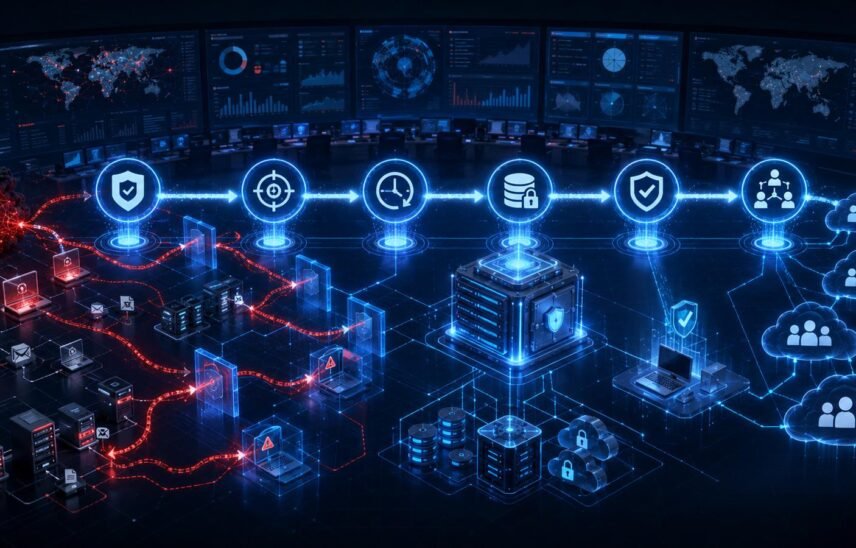
Ransomware continues to evolve beyond traditional file encryption. Today’s ransomware operators increasingly combine unauthorized access, privilege escalation, lateral movement, data theft, and extortion to maximize pressure on targeted organizations.
Recent threat intelligence reporting highlights several techniques associated with modern ransomware operations. These developments provide important lessons for organizations seeking to strengthen their cybersecurity defenses.
This article examines common attack techniques, the abuse of legitimate Windows administrative utilities, and practical security measures organizations can implement to reduce their exposure.
Modern ransomware operations frequently employ a double-extortion approach.
Rather than simply encrypting an organization’s files, attackers may:
This approach creates two distinct risks: operational disruption and unauthorized disclosure of sensitive information.
Even organizations with reliable backups remain vulnerable to data extortion if attackers successfully ex-filtrate confidential information.
Threat intelligence reporting associated with modern ransomware operations highlights several MITRE ATT&CK techniques that defenders should understand.
| Attack technique | MITRE ATT&CK ID | Security implications |
|---|---|---|
| Phishing | T1566 | Compromised users and initial access |
| Valid Accounts | T1078 | Abuse of legitimate credentials |
| External Remote Services | T1133 | Unauthorized remote access |
| Exploit Public-Facing Application | T1190 | Exploitation of exposed applications |
| Remote Services | T1021 | Lateral movement |
| Windows Management Instrumentation | T1047 | Remote execution |
| Service Execution | T1569.002 | Execution through Windows services |
| Archive Collected Data | T1560.001 | Preparing information for extraction |
| Inhibit System Recovery | T1490 | Disabling recovery mechanisms |
These techniques are not necessarily used in every ransomware incident. Their relevance is that they represent attack behaviors organizations can monitor and defend against.
Attackers do not always rely on sophisticated malware. They can abuse legitimate Windows administrative utilities already available within an organization’s environment.
Examples include:
PsExec: Can be abused to execute commands remotely and facilitate lateral movement.
Windows Management Instrumentation (WMI): Can support remote execution and administrative operations across endpoints and servers.
PowerShell: Can be used for scripting, reconnaissance, execution, and other post-compromise activities.
7-Zip and WinRAR: Can be used to compress collected information before transferring it outside the network.
VSSAdmin and Disk-shadow: Can be abused to delete or manipulate Volume Shadow Copies, potentially making recovery more difficult.
BCDEdit: Can be used to modify Windows boot and recovery configurations.
These tools are not inherently malicious. They are commonly used for legitimate IT administration. The security concern arises when their execution is unexpected, unauthorized, or inconsistent with established operational patterns.
Organizations should therefore focus on behavioral monitoring, command-line analysis, account context, and process relationships rather than automatically treating every execution as malicious.
Compromised credentials remain an important pathway into enterprise environments.
Recommended controls:
Organizations should not assume that a compromised endpoint represents an isolated incident.
Recommended controls:
Data theft can create significant business, regulatory, and reputation consequences even when systems are not encrypted.
Recommended controls:
Ransomware operators may deliberately target recovery mechanisms to increase the impact of an attack.
Recommended controls:
Organizations should have visibility into suspicious endpoint behavior before an attack progresses into widespread compromise.
Recommended controls:
Security teams can use Microsoft Defender XDR, other EDR platforms, SIEM solutions, and network monitoring technologies to investigate suspicious activity.
| Activity | What to investigate |
|---|---|
| PsExec execution | Unexpected remote execution and service creation |
| WMI activity | Unusual remote process creation |
| Archive utilities | Unexpected compression of large data collections |
| VSSAdmin activity | Shadow-copy deletion |
| Diskshadow activity | Unauthorized manipulation of recovery infrastructure |
| PowerShell | Encoded commands, suspicious scripts, and unusual parent processes |
| Outbound traffic | Unexpected large data transfers |
| Authentication | Unusual logins and abnormal privileged account usage |
An individual event should not automatically be classified as malicious. Effective investigation requires correlating process activity, user identities, device history, network connections, and surrounding events.
One of the most important lessons from modern ransomware operations is that traditional antivirus protection alone is insufficient.
An attacker using legitimate credentials, native Windows utilities, and authorized administrative tools may be difficult to identify through signature-based detection alone.
Organizations need a layered security strategy combining:
The objective should be to detect and contain suspicious activity before attackers can achieve their objectives.
Ransomware is no longer simply about encrypting files and demanding payment. It is increasingly about gaining access, moving through enterprise environments, collecting valuable information, and creating operational and reputation pressure through extortion.
Organizations of every size should understand these attack patterns and proactively assess whether their security controls can detect and contain them.
The best time to prepare for a ransomware attack is before an attacker gains access.
NEHAR Consult LTD helps organizations strengthen their cybersecurity posture through:
Learn. Remember. Prevent.
NEHAR Consult LTD
Securing Today. Protecting Tomorrow.
Website: https://neharconsult.com
Disclaimer: This publication is intended for cybersecurity awareness and educational purposes. References to threat intelligence and attack techniques should not be interpreted as confirmation of a breach involving any particular organization.